
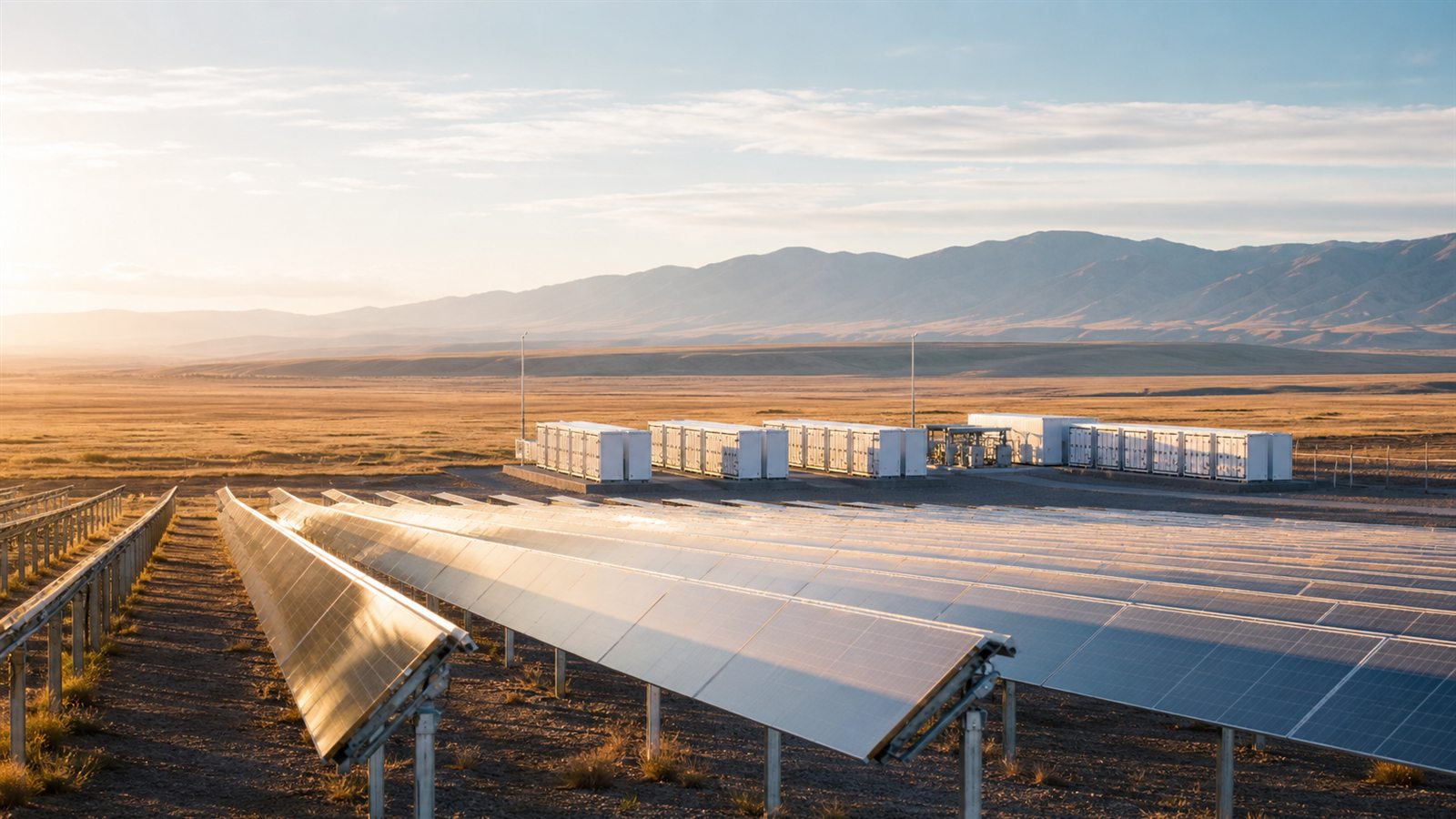
NASA’s Earth Observatory has documented the Green River Energy Center in Utah, an operating utility-scale project that combines 400 MW of solar generation with 400 MW of battery storage. The facility entered service in June 2026 and is visible in satellite imagery as a field of nearly one million solar panels alongside battery infrastructure.
Key facts
- Green River Energy Center has 400 MW of solar generation capacity.
- It also includes 400 MW of battery storage power capacity.
- NASA reports that the project came online in June 2026.
- The site uses nearly one million panels and roughly 500 batteries.
- It can use transmission lines that were originally built to serve coal-fired generation.
Why it matters
The project is a practical example of how solar, storage and existing grid assets can be combined at utility scale. Pairing generation and batteries at the same site gives the operator more flexibility than solar alone: stored energy can be dispatched beyond the middle of the day, and the facility can better manage output changes or support grid needs when generation is lower.
The use of transmission infrastructure associated with former coal generation is equally relevant. Interconnection is frequently one of the slowest and most expensive parts of a new power project. Where existing lines and substations can be safely upgraded or repurposed, they may shorten development pathways and make formerly fossil-dependent areas more attractive for clean-energy investment.
For suppliers, Green River is a reminder that the utility market is increasingly an integrated systems market. Modules, racking, battery containers, power-conversion equipment, transformers, control software and grid studies must work together. Companies following U.S. projects should look beyond headline capacity to operating data, delivery partners and the project’s approach to interconnection and long-term asset management.
Sources
SolarXList summary based on NASA material checked on July 27, 2026.